

History
Da Vinci Days Festival
About da Vinci Days Festival
Born from a simple idea—put Corvallis on the map—da Vinci Days began in 1989 as a bold experiment in community creativity. A small group of local leaders from the Convention & Visitor Bureau, the Downtown Association, and Corvallis Parks & Rec, noticed something missing from Oregon’s tourism map: Corvallis. What followed was a wildly ambitious plan to showcase what made this town special—its unique blend of arts, science, and technology.
"CATS" was the first name for the event (Corvallis Arts, Technology and Science). At one meeting, Keith Mobley, OSU's Community Relations Director commented, "It sounds like we're talking about Leonardo da Vinci." Inspired by the spirit of da Vinci, the festival quickly took on a life of its own. The first event, largely funded by the city, the county, and OSU, featured everything from a touring exhibit of da Vinci’s inventions tucked into the public library stacks, to a “Car Concert” in Central Park, to a keynote speaker who had just discovered the Titanic. It was clear from the start that this was not going to be an ordinary festival.

Over the next three decades, da Vinci Days grew into a beloved summer tradition. It filled OSU’s campus and beyond with live music, hands-on science exhibits, quirky performances, local food, and family-friendly creativity. The Children’s Village, community art projects, and interactive demonstrations became staples, while the festival continually evolved with new ideas and energy. In 1993, the Corvallis Kinetic Sculpture Race joined the lineup, later becoming today’s Graand Kinetic Challenge.
Why the da Vinci Days Festival Ended
Like many long-running community events, da Vinci Days faced growing challenges over time. Declining sponsorships, rising production costs, and shifts in how people attend and support festivals made sustainability increasingly difficult. The festival paused in 2014–2015 to reimagine its future and returned in a new format—but the landscape had changed.
In 2020, the COVID-19 pandemic dealt a final, significant blow. Major fundraising events were canceled, sponsors faced their own uncertainties, and there was no clear financial path forward. Unfortunately, the board made the difficult decision to end the annual festival.
For nearly 30 years, counting a three-year hiatus- da Vinci Days existed to celebrate our community of artists, engineers, teachers, and visionaries while supporting the economic development and vitality of Corvallis and Benton County.
We're still all about STEAM and showcasing our community's creativity and innovation, and kinetic sculpture racing has always been a great way to do that! In fact, it's easy to imagine da Vinci, himself, was creating and piloting one of these fanciful contraptions. While we will always miss our unique, home-grown festival, the da Vinci Days organization is now pouring our energy and resources into the iconic Graand Kinetic Challenge, commonly known as the GKC. As always, the GKC will be held every year during the third weekend in July, here in Corvallis. As ever, it's FREE, it's FUN, and it's FAANTASTIC!

da Vinci Days Today
Today, da Vinci Days Inc. continues as a nonprofit organization, carrying forward its mission in a new way—through the Graand Kinetic Challenge and other creative S.T.E.A.M. related endeavors, such as partnering with OSU’s STEM Research Center’s da Vinci Days-in spirit event, Corvallis Kaleidoscope.
At its core, the mission remains unchanged:
To present the Graand Kinetic Challenge and other events that showcase the educational, artistic, scientific, and technological assets of the region, while promoting and contributing to the economic wellbeing of the City of Corvallis and Benton County.

The Founder
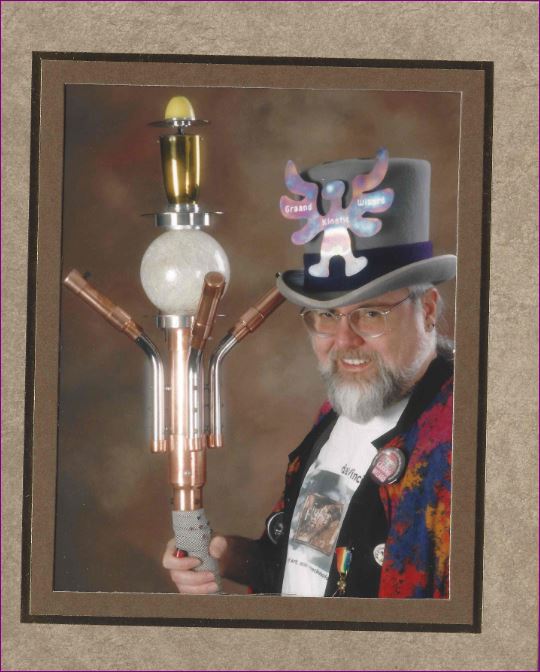
Raan Young
Engineer. Instigator. Graand Wizard.
Every great story starts with a spark.
For the Graand Kinetic Challenge, that spark came from Raan Young—an engineer, problem-solver, and self-described “young nerd” who believed that imagination and engineering should live in the same space.
The Moment
That Started It All
Long before the first kinetic sculpture rolled through Corvallis, Raan had his own moment of inspiration.
In 1972, while working at the University of Washington, he encountered one of the first handheld scientific calculators, the HP-35. It wasn’t just a tool. It was a revelation. Powerful computing, small enough to hold in your hand.
That moment set him on a path.
Raan taught himself programming, immersed himself in early computing culture, and eventually joined Hewlett-Packard’s Corvallis division, which at that time was a hub of innovation for handheld and portable computing. As a software engineer, he helped develop early portable systems, always drawn to the idea of small, powerful, imaginative machines.
Years later, that same idea would take on a very different form.


The Idea
"Let's Do This Here!"
In 1992, Raan was introduced to the world of kinetic sculpture racing through a series of chance connections. An adventurous cyclist, a photographer named Maggie, and a New Year’s trip to Arcata, California, home of the original kinetic races founded by Hobart Brown.
There, he met builders and racers creating outrageously ingenious, pedal-pushed machines that were part engineering, part art, part absurdity.
He came back to Corvallis with a simple thought:
This belongs at da Vinci Days.
A Legacy in Motion
In 2008, the race was renamed the Graand Kinetic Challenge in honor of its founder.
What began as a small experiment with limited funding has grown into a long-standing Corvallis tradition. The course still challenges teams to navigate road, sand, mud, and river while powered entirely by human effort and fueled by creativity. In Corvallis, the event is a beloved tradition.
And at its core, it still reflects Raan’s original vision:
- Build something improbable.
- Figure It Out as You Go.
- Invite Others Along for the Ride.